TIP for a visit
His life and work is the subject of MENDELIANUM, an interactive museum and centre G. J. Mendel, located in the authentic premises of the Mendel Scientific Society in the historical heart of Brno.
Gregor Johann Mendel (1822 – 1884)
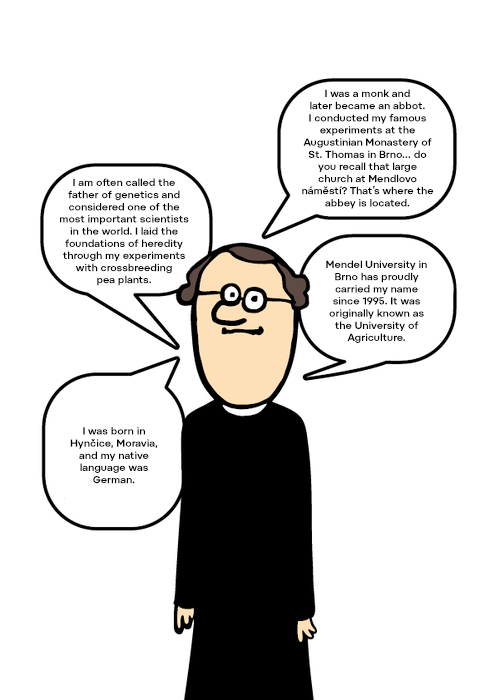
He was born on 20 July 1822 in the family of a farmer in the village of Hynčice (now part of the municipality of Vražné - Nový Jičín district) in Moravia. Mendel's mother language was German. After graduating from the primary school in Hynčice and the gymnasium in Opava, he enrolled at the Philosophical Institute of the University of Olomouc in 1840. In 1843 he was admitted as a novice to the Augustinian monastery of St. Thomas in the Old Brno. At that time he received the religious name Gregor. The Brno Augustinians were scholars who were involved in university and grammar school education in the monarchy at that time. At that time they occupied an important position in the scientific and cultural life of Moravia. In 1853, he completed a two-year course of study at the University of Vienna.
In 1856, Mendel began his experiments with plant hybridization (with peas) and in 1862 he started meteorological observations for the Meteorological Institute in Vienna. He carried out meteorological observations with great precision until almost the end of his life.
In 1863 he ceased his experiments with the pea, and on 8 February 1865, at a meeting of the Natural History Society in Brno, nine years after Darwin's book ‘On the Origin of Species’, he presented the first part of his theory of the transmission of hereditary units. In 1866 his work Versuche über Pflanzen-Hybriden.
In 1868 he was elected abbot and prelate of the Augustinian monastery in Brno. In 1883 Mendel fell seriously ill and died in the monastery on 6 January 1884 and was buried in the Augustinian cemetery in Brno. The requiem in the church was later conducted by the world-famous composer Leoš Janáček.
Mendel's research activities
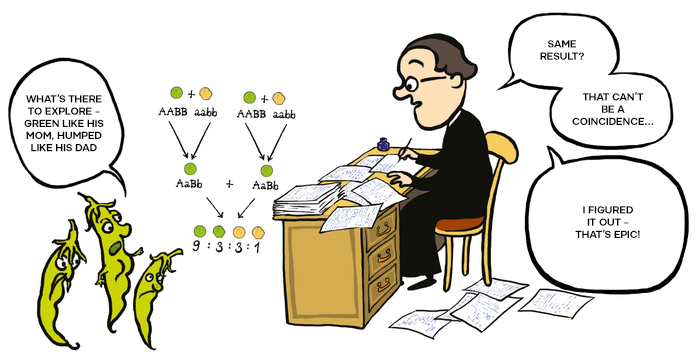
Mendel considered the variability of plants to be a documented fact. He was the first to make a significant breakthrough - he was the first not to evaluate the organism as a whole, but to break it down into its individual characters. He understood the individual features (e.g. the shape of a ripe seed) as opposites, e.g. round on one side and square on the other - like two sides of the same coin. He evaluated the transfer of their qualities. In his conception, the initial maternal and paternal cells did not merge in the offspring, but the aptitudes for the individual characters of the maternal and paternal plants were united. The novel diagnostic method allowed Mendel to evaluate the results of crossing seven pairs of traits in peas, all of which were based on the principle of dominance and recessiveness of opposite traits.
Mendel's laws of inheritance
He formulated the basic laws of inheritance in 1866 based on analyses of genetic crosses between bred strains of peas differing in a well-defined trait such as seed shape (round or square), seed colour (yellow or green) or flower colour (purple or white). Mendel found that crossing parents differing in a single trait (e.g. seed shape) produces offspring in which all individuals have the trait of only one parent. For example, round seeds showing dominant, alternative traits are called recessive.
Mendel explained this observation by hypothesizing that the different pairs of contrasting traits are each the result of a factor (now called a gene) that has alternative forms (alleles). Each plant contains a pair of genes determining a particular trait, having acquired one gene from each parent. He also demonstrated that different traits are inherited independently.